Are the two people in “American Gothic” husband and wife?
The artist later said they were father and daughter. But his first biographer wrote that the pair began life as a farmer and his wife.
62years old
A long-faced man holding a three-pronged pitchfork stares straight out at us, while beside him a woman with tightly pinned hair glances away. Behind them stands a white house with a pointed window. American Gothic, painted by Grant Wood in 1930, is one of the most famous paintings in America.
The two are often taken for a farm couple. When the painting first caused a stir, newspapers outside Wood’s home state of Iowa usually called it a farmer and his wife. But the artist and the people around him told a rather different story.
A sister and a dentist
Wood was based in Cedar Rapids, Iowa. The woman was modeled on his sister, Nan Wood Graham, eight years his junior. The man was modeled on Wood’s dentist, Dr. Byron McKeeby.
According to the first biography of the painter, Darrell Garwood’s Artist in Iowa (1944), Wood was fascinated by McKeeby’s face. “I like your face,” he told the dentist once. “Because it’s all long straight lines.” When he asked the two to pose, he promised that he would stretch their faces out so far that no one would ever recognize them. Everyone who knew them recognized them at once.
The American Gothic House Center, which looks after the house in the picture, notes that the two models never posed together. The scene was put together by Wood in his studio.
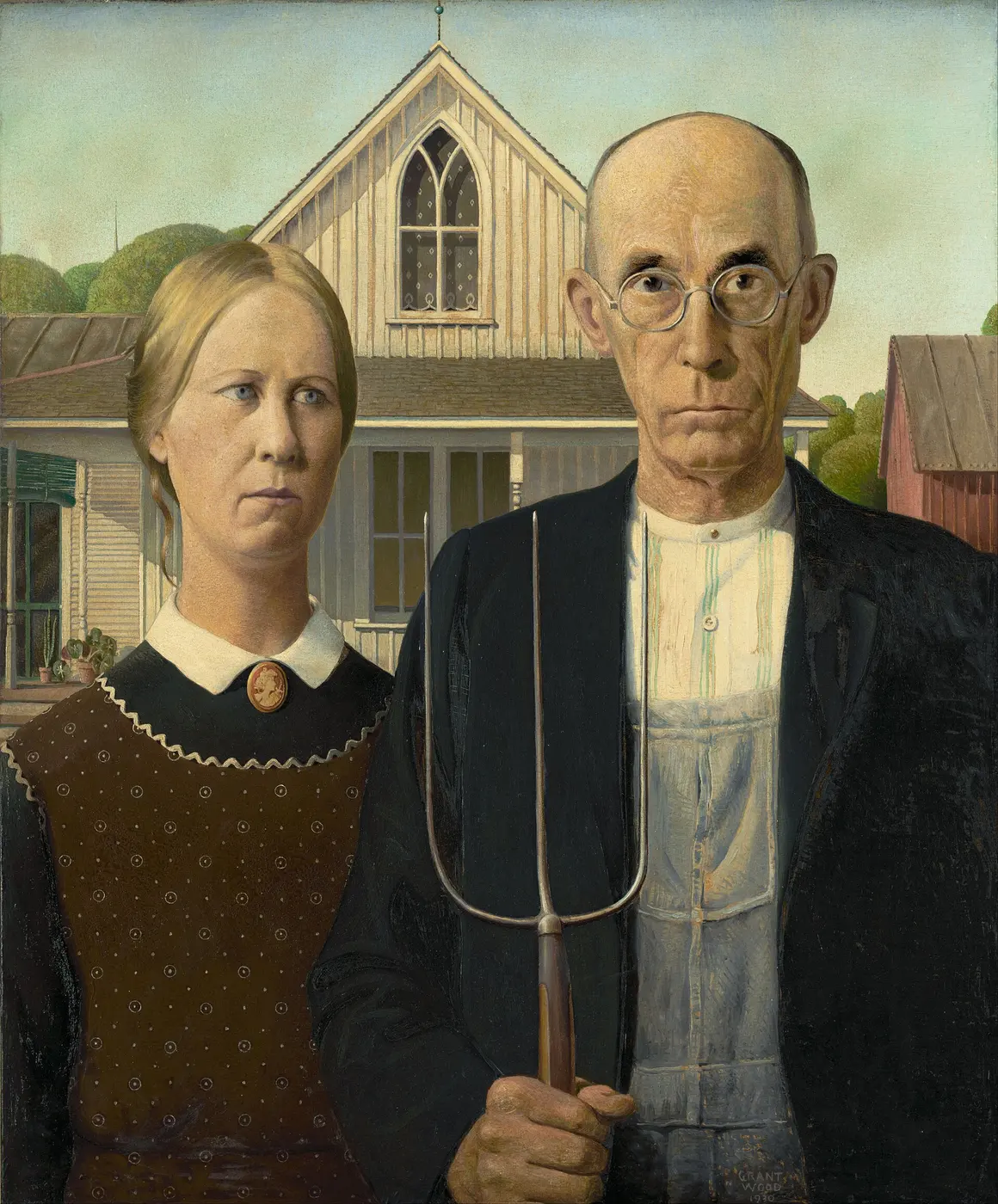

Husband and wife, or father and daughter?
So how were the two meant to be related? According to Garwood, Wood first planned to paint a farming couple. But Nan was about 30 and McKeeby was 62, and calling them husband and wife began to seem odd. So, in Garwood’s words, what had started out to be a farmer and his wife became a small-town businessman and his daughter. Wood also had other reasons for the change: McKeeby did not look much like a farmer, and Wood was worried about how real farmers would react.
Wood rarely explained his work. But in a letter written in 1941, the year before he died, he explained that “the prim lady with him is his grown-up daughter.” Nan, too, said that her brother had imagined the pair as father and daughter. Today the Art Institute of Chicago describes the painting as showing a farmer and his daughter.
The “Gothic” is the window
The house in the background still stands in Eldon, a small town in southern Iowa. Wood visited the town for an exhibition in the summer of 1930, spotted the house while being driven around, and made a sketch of it.
Built in the early 1880s, it is a modest wooden house with a pointed, church-like window under the gable. Decorating simple wooden houses with Gothic details like this was a 19th-century American fashion known as Carpenter Gothic. According to the State Historical Society of Iowa, the window is where the painting got its name. Wood later said he found the window amusing, and called it “pretentious” for such a small house.
The window was not purely for show, though. The American Gothic House Center says it is hinged, and was used to move large furniture in and out of the upper floor, since the narrow inside staircase could not take a bed or a dresser.
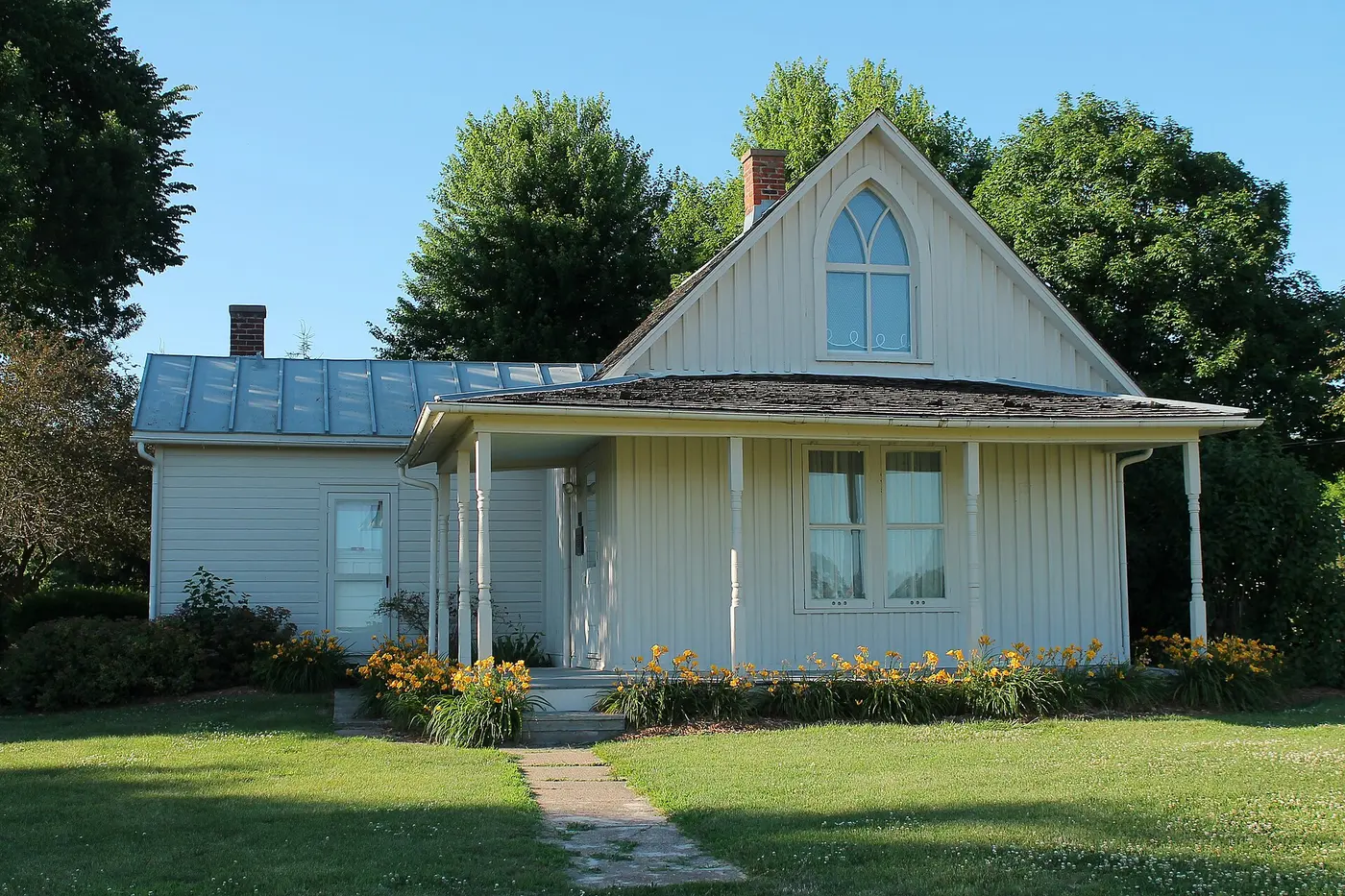

Satire or tribute?
In the fall of 1930 the painting was shown at the Art Institute of Chicago’s annual exhibition, where it won a prize and was bought by the museum. Newspapers across the country reproduced it, and Wood became famous almost overnight.
According to the Art Institute, many viewers took the painting as satire aimed at Midwesterners out of step with the modern world. Garwood reports that Wood received about a hundred letters of protest and a half dozen angry phone calls. Garwood believed that Wood had indeed set out with some satire in mind. The Art Institute, however, says that Wood meant to convey a positive image of rural American values.
What annoyed Wood most was the complaint that the couple were not typical Iowa farm people. He finally made it a rule not to answer any letter containing the word “typical.” “I never paint anything that is typical,” he said, “because if I did I would have to leave out all the interesting detail.”