Why did table tennis balls get bigger?
To make a too-fast game easier to watch. In 2000 the ball grew from 38 to 40 millimeters, which took a little off its speed and spin.
40mm
A table tennis ball is so light that you can barely feel it resting in your palm. Today’s official ball measures 40 millimeters (about 1.6 inches) across and weighs 2.7 grams. In a rally between top players, this featherweight flies back and forth across the table almost too fast to see.
Yet that 40-millimeter standard is not very old. Until the autumn of 2000, table tennis balls were a size smaller, at 38 millimeters. So why go to the trouble of making the ball bigger?
Too fast to follow
Toward the end of the 20th century, table tennis was getting faster and faster. Players were using thicker sponge under the rubber on their rackets, letting them put tremendous speed and spin on the ball.
Speed was a sign of the sport evolving, but it brought a problem. Rallies were over in an instant, and on a TV screen it was hard to follow where the ball was going. If viewers can’t enjoy a sport, it gets less airtime and its popularity struggles to grow. The International Table Tennis Federation (ITTF) set out on a series of reforms to make table tennis more enjoyable to watch on television.
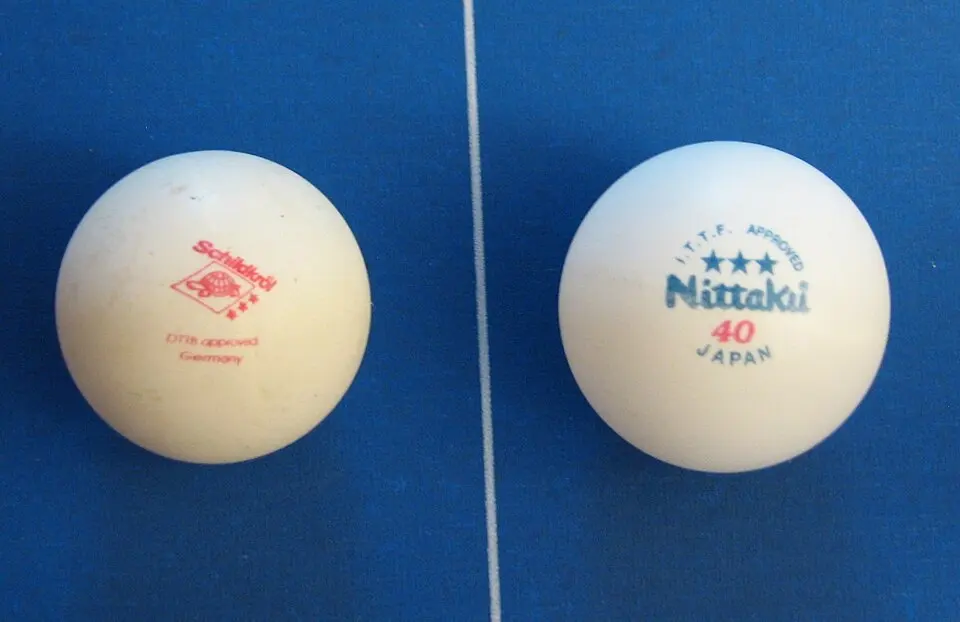

Two millimeters bigger, 0.2 grams heavier
The centerpiece of those reforms was a bigger ball. The ITTF decided to switch international competition to a 40-millimeter ball, and the change took effect on October 1, 2000, just after the Sydney Olympics. The diameter went from 38 to 40 millimeters, and the weight from 2.5 to 2.7 grams.
A diameter about 5 percent larger means a ball whose silhouette, seen head-on, is about 11 percent larger. A bigger ball presents more surface to the air, so it slows down more as it flies. And being bigger and heavier, it is also harder to spin.
How much difference did it actually make? In experiments published in 2000 by researchers at the Toyama Industrial Technology Center in Japan and their colleagues, balls hit by players traveled about 2 to 4 percent slower on average with the 40-millimeter ball. When a golf-swing robot hit both balls under identical conditions, the starting speed differed by only 1 to 2 percent, but the 40-millimeter ball carried 5 to 20 percent less spin. Those numbers may look small, but heavy spin that forces errors is one of table tennis’s biggest weapons. Losing up to a fifth of it is no small matter for a player.
Not just the ball
More TV-friendly reforms followed. In September 2001, games went from 21 points to 11, and serve changed hands every two points instead of every five. Each point mattered more, and matches moved faster. In 2002, players were also banned from hiding the ball with their body or arm while serving.
Players adapted quickly, though. Physicists at the University of Greifswald in Germany note that match analyses showed no clear difference, because players made up for the bigger ball by putting in more effort, using their legs and their whole body to generate power. Perhaps those 2 millimeters mostly forced players to rebuild their strokes.
From celluloid to plastic
Size was not the only change. For more than a century, table tennis balls were made of celluloid, but from July 1, 2014, ITTF events switched to plastic balls.
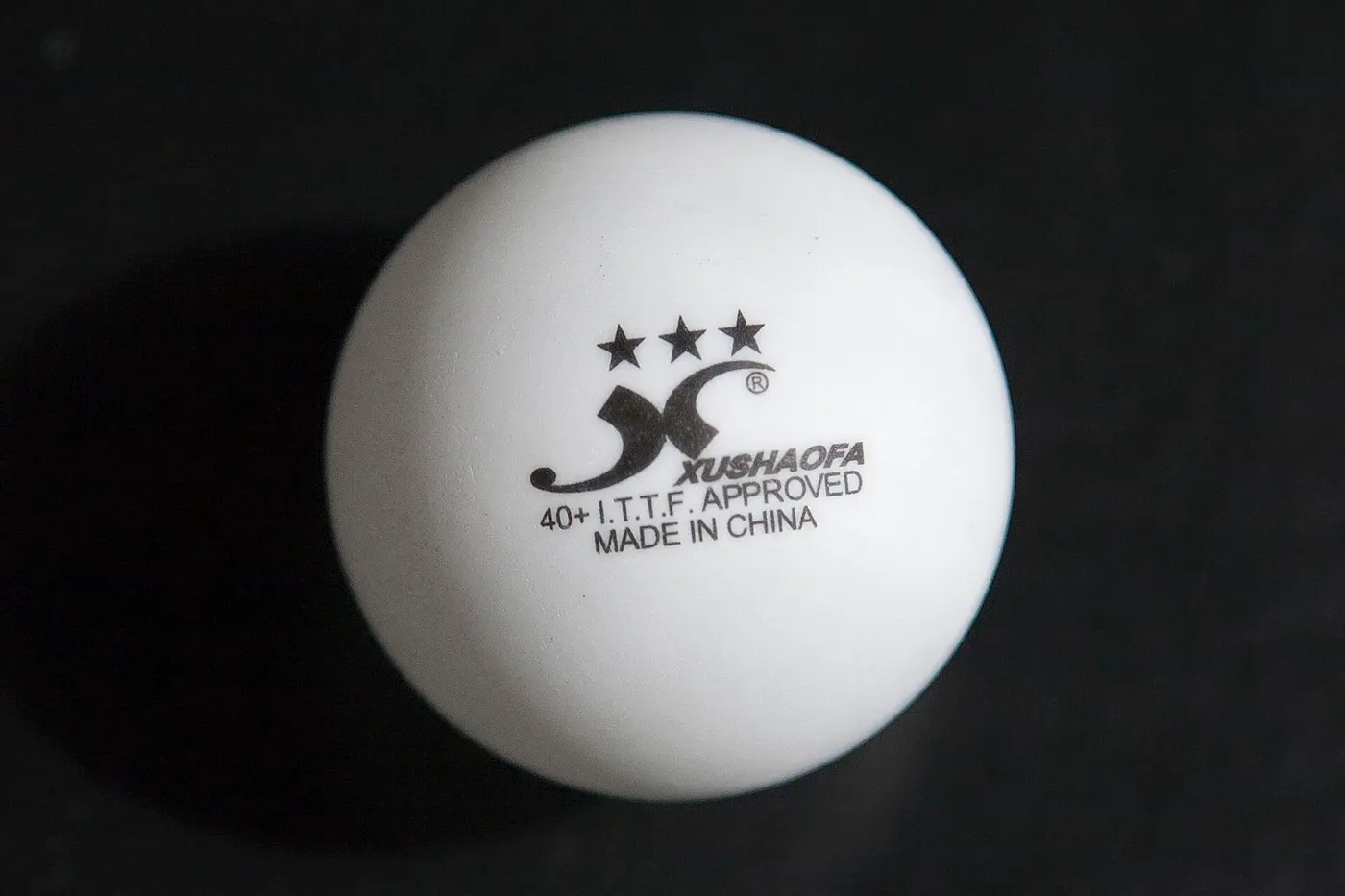

The reason was that celluloid is highly flammable. It could not be shipped by air without special fireproof containers, and more and more countries had stopped producing it. Adham Sharara, then president of the ITTF, explained that the supply of the celluloid sheets used to make balls was dwindling and would eventually run out. Plastic balls are made slightly larger, which is one reason they are labeled “40+.”