Is polar bear fur really white?
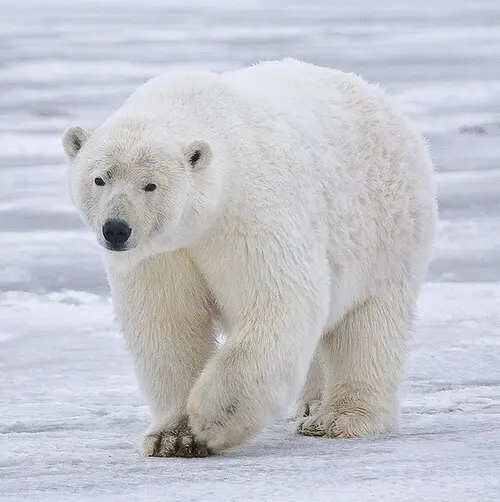
Not exactly. The hairs have no pigment and are transparent; they look white because light scatters inside and around them. Underneath, the bear’s skin is black.
Polar bears are famous for their snow-white coats. Yet their hair contains no white pigment at all. Each hair is transparent, and the whiteness is a trick of the light. Under all that fur, the skin is black.
That combination of clear hair and black skin once inspired a popular idea: that the hairs work like optical fibers, piping sunlight down to the skin to warm the bear. It was an elegant story. When someone finally measured it, it turned out not to be true.
Clear, hollow hairs
A polar bear’s coat has two layers: thick, stiff outer hairs over a dense layer of fine, soft underfur. According to the San Diego Zoo, although polar bears look white, their hair is actually made of clear, hollow tubes filled with air. The Sapporo Maruyama Zoo in Japan also describes the hairs as transparent and hollow.
A 1979 report in Nature adds a detail: the hollow hairs are the wider outer guard hairs, about 0.05 to 0.2 millimeters thick. The underfur hairs beneath them are less than 0.02 millimeters thick and not hollow.
Colorless hair looks white for the same reason snow does. Each ice crystal in snow is clear, but when countless crystals pile up, light bounces off their surfaces in every direction, and the mix of all those colors reaches our eyes as white. In a polar bear’s coat, layer upon layer of transparent hairs scatter light at their surfaces and in their hollow cores, and the coat looks white.
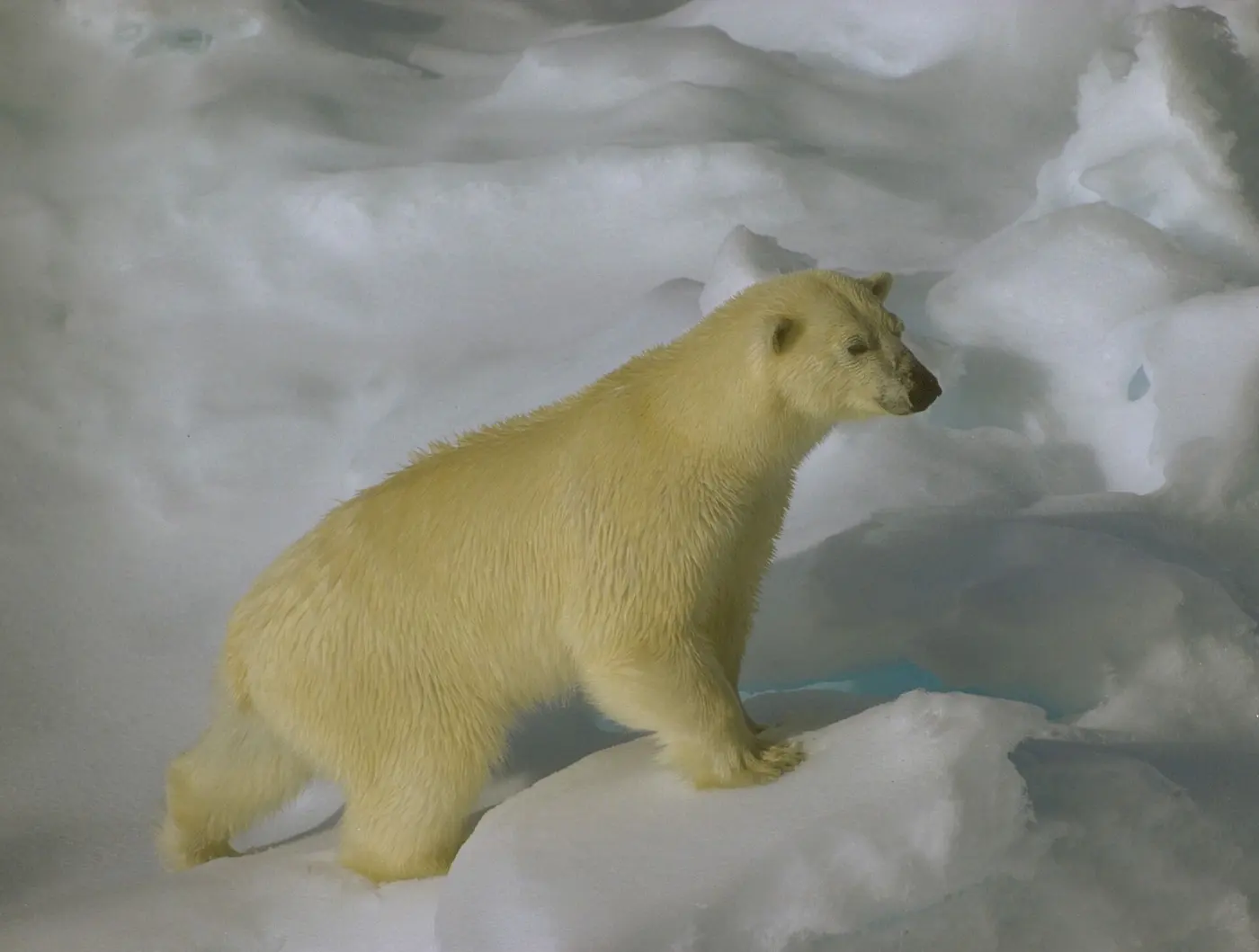
The coat is not always pure white, either. The San Diego Zoo notes that oils from the bear’s diet, oxidation from the sun, and dirt can make it look cream-colored or yellowish.

Black skin underneath
Part the fur, and you find black skin. You can see it on the parts that have no fur, such as the nose and lips.
Black absorbs light well. Some researchers wondered whether transparent hair over black skin might be a clever way of soaking up the sun’s heat.
There was another clue. In the 1970s, researchers in Canada and Norway had reported that when polar bears are photographed through a filter that passes only ultraviolet light, they show up black against the white snow. Snow reflects ultraviolet light, but the fur reflects very little of it. The technique was developed to help count animals from the air, since white animals are hard to pick out against white snow in ordinary photographs.
The fiber-optic theory
In 1980, a paper in the journal Applied Optics proposed a model: light, especially ultraviolet light, bouncing along inside the hollow hairs could be guided down to the black skin and turned into heat. The reason so little ultraviolet came back from the fur, in other words, was that the hairs were channeling it to the skin like optical fibers.
According to the Geophysical Institute at the University of Alaska Fairbanks, the idea spread through the Christian Science Monitor, the New York Times and Time magazine. But no one had actually checked how far light could travel inside a hair.
That job fell to Daniel Koon, a physicist at St. Lawrence University in New York State. With a student, he tested hairs from a male polar bear at a zoo in Rochester, New York, to see how much light passed along them. Along a typical hair about 2.5 centimeters (1 inch) long, less than 0.001 percent of red light made it to the end, and less than a trillionth of violet light. Even less ultraviolet got through. The likely culprit is keratin, the protein that hair is made of, which absorbs ultraviolet light. Koon published his results in 1998 in the same journal, Applied Optics.

So the bears look black in ultraviolet photographs because their hair absorbs ultraviolet light, not because it ferries the light to the skin. With hardly any light reaching the skin, the fiber-optic theory collapses. The air-filled hollows are thought instead to help keep body heat in and to make the bear more buoyant in water. Exactly how the structure of the hair interacts with light, though, is still debated among researchers.