What causes the Naruto whirlpools?
The tides on either side of the Naruto Strait run about six hours apart, so the water piles up on one side and races through. Whirlpools spin up where the fast central current meets slower water near the shores.
1.5m
In the Naruto Strait, between the city of Naruto on the island of Shikoku and Awaji Island to the northeast, the tidal current spins into whirlpools, the largest more than 20 meters (66 feet) across. Sightseeing boats edge up to them, and passengers cheer from the deck.
But why should water whirl like that in the open sea? The explanation leads to a large island that puts the tides out of step.
High tide, six hours late
The Naruto Strait links the Harima Sea, part of Japan’s Seto Inland Sea, to the north with the Kii Channel to the south. At its narrowest it is only about 1.3 kilometers (0.8 mile) wide.
According to Japan Tourism Agency explanatory text and materials from the city of Minamiawaji, the tidal wave arriving from the Pacific splits in two in the Kii Channel. One part goes straight to the southern end of the strait and brings high tide there. The other travels into Osaka Bay, out through the Akashi Strait and around the Harima Sea, reaching the northern end of the Naruto Strait about six hours later. By then, the southern end is at low tide.
So the tides at the two ends of the strait run exactly opposite, and the sea surface on one side can stand as much as 1.5 meters (5 feet) higher than on the other. The water rushes from the high side to the low side. The current reverses roughly every six hours, and during spring tides it can reach about 20 kilometers per hour (12 mph). A report by the Japan Coast Guard describes it as the fastest tidal current in the country.
Where fast water meets slow
Why does a fast current turn into whirlpools?
According to Minamiawaji’s materials, the seabed of the strait is V-shaped in cross section. In the deep middle there is little to slow the water, so the current runs fast. Near the shores, shallows and other obstacles hold it back. Where these two streams of different speeds meet, the water starts to rotate, and whirlpools form.
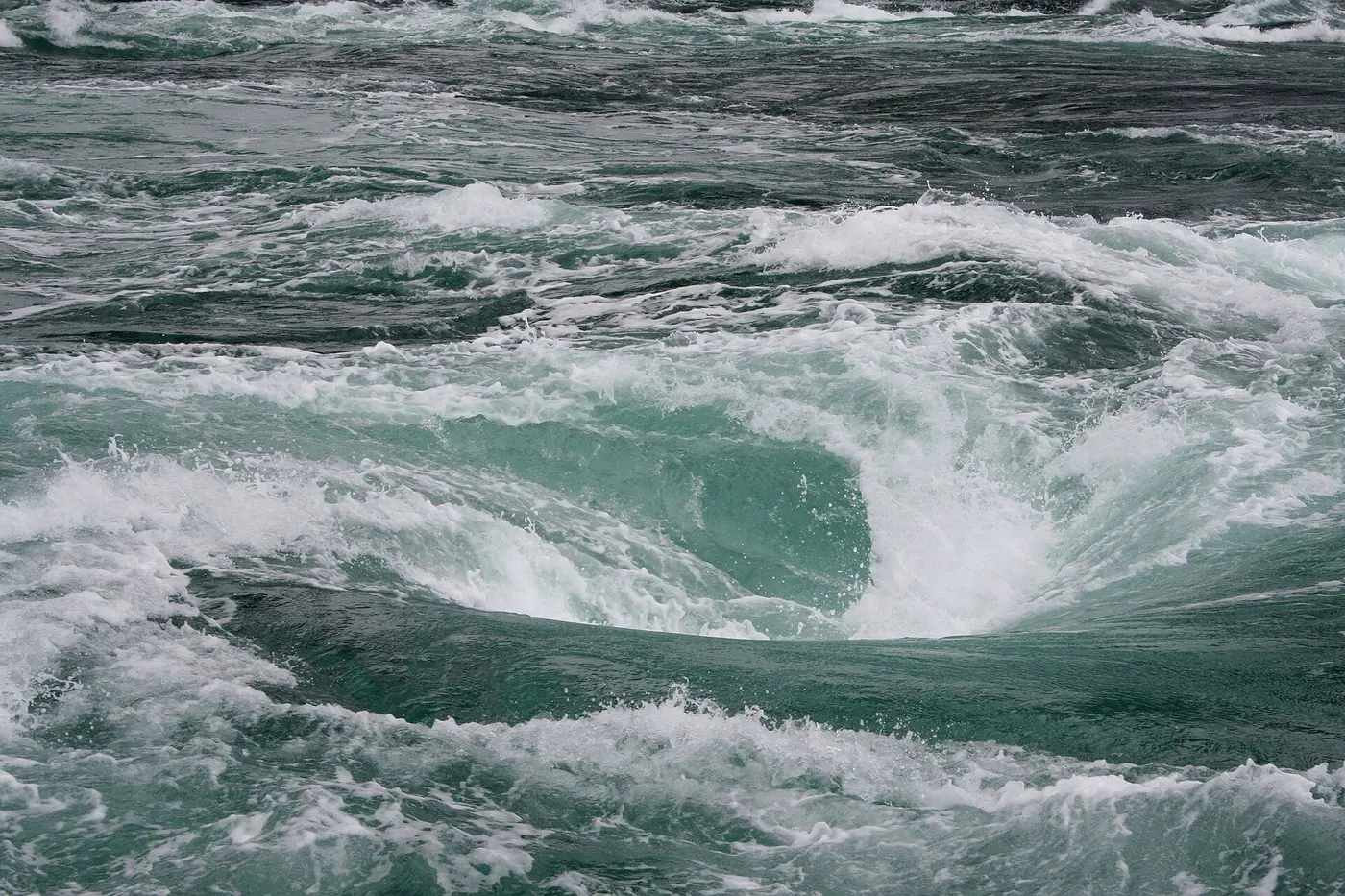

They appear on the downstream side. According to the Heibonsha World Encyclopedia, when the current flows north they form on the Harima Sea side, and when it flows south they form on the Kii Channel side.
The Japan Tourism Agency text describes several patterns. In one, a pair of whirlpools spins in opposite directions on either side of the fast current racing down the middle of the strait. In another, an upwelling driven by the complex seabed makes the surface swell into a round mound. In the most spectacular, as many as seven whirlpools line up in a row. Each typically lasts only 20 to 30 seconds.
The current has carved the seabed too. According to Japanese encyclopedias, the channel is about 90 meters (295 feet) deep at its center, and just beyond the strait the current has scoured bowl-shaped hollows reaching 217 meters (712 feet) deep on the north side and 153 meters (502 feet) on the south.
How big are they?
Sources disagree on the size. Uzu-no-Michi, a walkway built into the bridge over the strait, says the whirlpools reach 20 to 30 meters across during spring tides in spring and fall, and Minamiawaji says they can reach about 30 meters. Encyclopedias variously describe several whirlpools about 10 meters across or a giant of more than 40 meters. Since whirlpools shift shape as they drift, the variation is hardly surprising.
For the best view, go during a spring tide. According to the Japan Tourism Agency, the whirlpools are strongest around the new and full moons, and are most powerful in spring and fall. Uzu-no-Michi says they grow largest around the times of high and low tide.
From ancient chronicles to Hiroshige
Naruto’s rushing tides have long been famous. According to the Nihon Daihyakka Zensho encyclopedia, the strait appears in the Nihon Shoki, a chronicle completed in 720, which says the tide there runs very fast. In the 10th-century Tosa Diary, the poet Ki no Tsurayuki describes setting out by boat in the middle of the night to avoid pirates and crossing the Naruto channel.
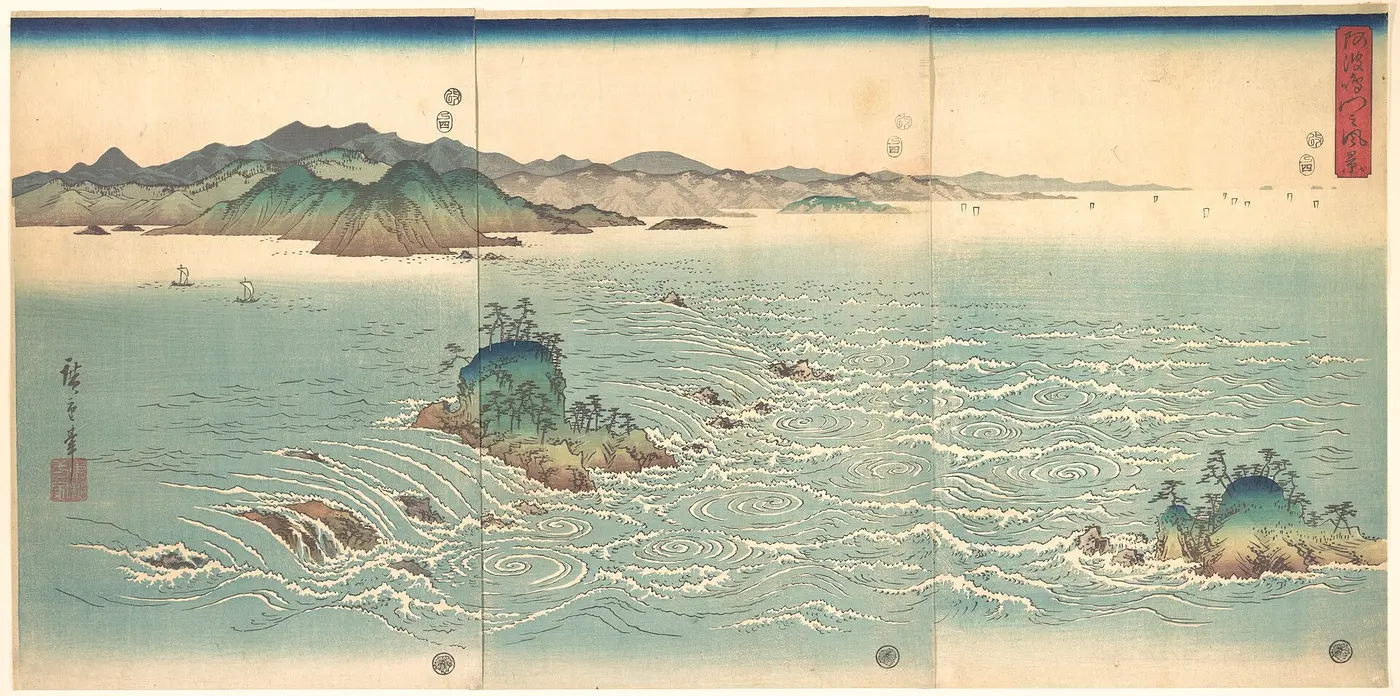
In 1857, near the end of the Edo period (1603–1868), the woodblock artist Utagawa Hiroshige (1797–1858) depicted them in Awa Naruto no Fūkei (The Whirlpools of Awa), a print of three sheets joined side by side, filling the wide picture with swirling water. According to the Japan Tourism Agency, prints like this and the accounts of the 19th-century German physician Philipp Franz von Siebold helped make the whirlpools known in Europe.

In 2014, government bodies and local groups in Hyogo and Tokushima prefectures formed a council seeking World Heritage status for the whirlpools. It has been studying their size, how they form and the geology of the strait, and working with whirlpool researchers in Norway and Scotland.