Does the setting sun really flash green?
Yes. The atmosphere bends each color of sunlight by a slightly different amount, so the top edge of the setting sun can turn green for a second or two.
1–2sec
Have you ever watched the sun set over the sea right to the very end? The red disk shrinks to a thin arc, then a dot, and then it is gone. In that final moment, the top edge of the sun sometimes turns green. This is the green flash.
It sounds hard to believe, and the green flash was long dismissed as a trick of the eye. But it is a real natural phenomenon, and it shows up in photographs.
A sunset that comes in layers
Earth’s atmosphere refracts sunlight slightly, making the sun appear a little higher than it really is. The effect is strongest near the horizon. According to the US Naval Observatory, refraction at the horizon averages 34 minutes of arc, or a little over half a degree. That is more than the sun’s apparent diameter of about 32 minutes, so when the bottom of the setting sun seems to touch the horizon, the whole sun is in fact already below it.
The key is that the amount of bending depends on color. Like a glass prism, the air bends green and blue light, which have shorter wavelengths, more strongly than red. In effect, the sky holds a red sun, a yellow sun, a green sun and a blue sun, each shifted very slightly above the last. The red image, lowest of all, sets first; the last to go is the edge of the green and blue images.
So why green and not blue? Light from near the horizon travels a long way through the air, and along the way blue and violet light is scattered out, the same process that makes the sky blue. In exceptionally clear air blue or violet can appear at the end, but usually green is the last color left.
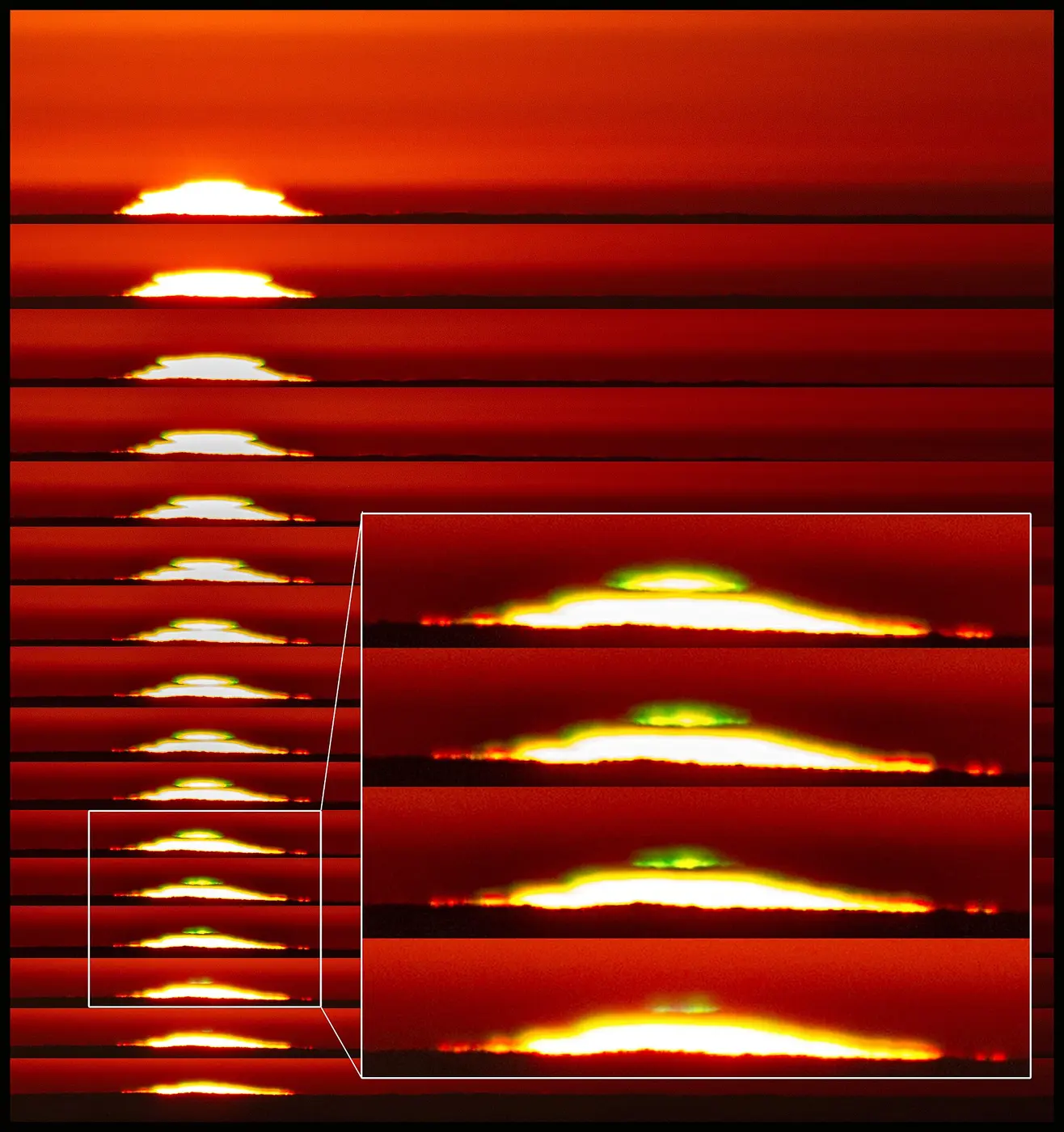

Andrew Young, an astronomer who has long studied green flashes and explains them on a San Diego State University website, says this green rim is normally far too thin to see. It shows only when a mirage, created by temperature differences in the air near the sea, stretches and magnifies it. At middle latitudes, he says, a flash typically lasts a second or two.
Not a trick of the eye
Stare at a red sunset and look away, and you may see a green afterimage. For a long time, many suspected that the green flash was nothing more than that. The Japanese encyclopedia Nipponica explains that it was accepted as real because it is also seen at sunrise, before anyone has been staring at the sun, and because it was captured in color photographs.
According to Young, the French astronomer and artist Lucien Rudaux photographed a sunset flash in the 1920s. In 1931, the French science magazine La Nature reported that it had been captured in color.
For the best chance, find a sea horizon
Young recommends two main conditions. The first is a horizon lower than your eye. The sea is ideal, and the temperature difference between water and air helps produce the mirages that make flashes visible. The second is clean air. With too much dust, haze or smog, not enough green light makes it through along the horizon.
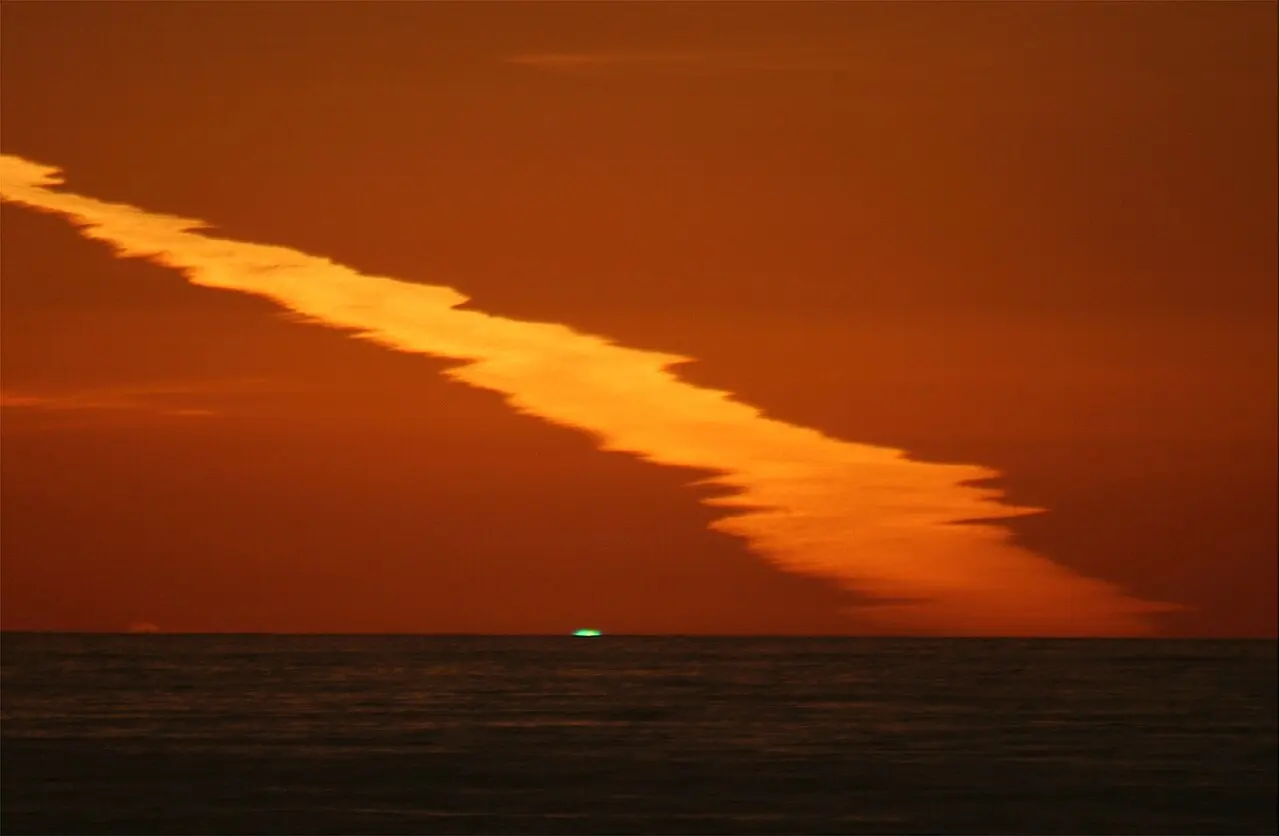

Binoculars help a lot. Watching ocean sunsets in San Diego with binoculars, Young sees some kind of green flash about five times out of six; with the naked eye, more like one in six. But binoculars turned on a sun that is still high can injure your eyes. Young advises waiting until the sun, touching the sea horizon, can be hidden behind your thumb held at arm’s length.
The legend Verne made famous
What made the phenomenon famous was The Green Ray (Le Rayon vert), an 1882 novel by Jules Verne. A young Scottish woman, Helena Campbell, declares that she will not settle the question of marriage until she has seen the green ray, and drags her uncles along the west coast of Scotland in search of it. A newspaper article quoted in the novel praises its color as “a green which no painter could ever obtain on his palette.”
Helena’s obsession comes from what is presented as an old Highland legend: whoever sees the ray can no longer be deceived in matters of the heart, and can see clearly into his own heart and the hearts of others.
It is a romantic story, but Young says no such legend exists in Scottish folklore. What is more, the correspondence between Verne and his publisher, Pierre-Jules Hetzel, published in 2002, shows that the “legend” was Hetzel’s invention, and that Verne adopted almost exactly the wording Hetzel proposed.
Near the end of the novel, Helena misses the green ray when it finally appears: at that very moment, she and the young man beside her, Olivier, are gazing into each other’s eyes.