Can quicksand swallow you whole?
No. Quicksand is about twice as dense as the human body, so you sink only to about your waist. Getting your legs back out, though, is very hard work.
2×
It is a classic scene in adventure films. A villain fleeing through the jungle steps into a patch of wet sand, struggles, sinks deeper and deeper, and finally disappears without a trace.
Quicksand is real, and getting stuck in it is no joke. But being swallowed whole, as in the movies, is something that essentially never happens.
Sand that has lost its footing
According to a 2005 news story in the journal Nature, quicksand is simply ordinary sand so saturated with water that the friction between the grains is reduced, leaving it unable to bear weight. It is most common near the deltas of large rivers, and it can also form after an earthquake forces water up from underground.
The sand itself is no different from the sand on a beach or a riverbank. What makes it treacherous is the water filling the spaces between the grains.
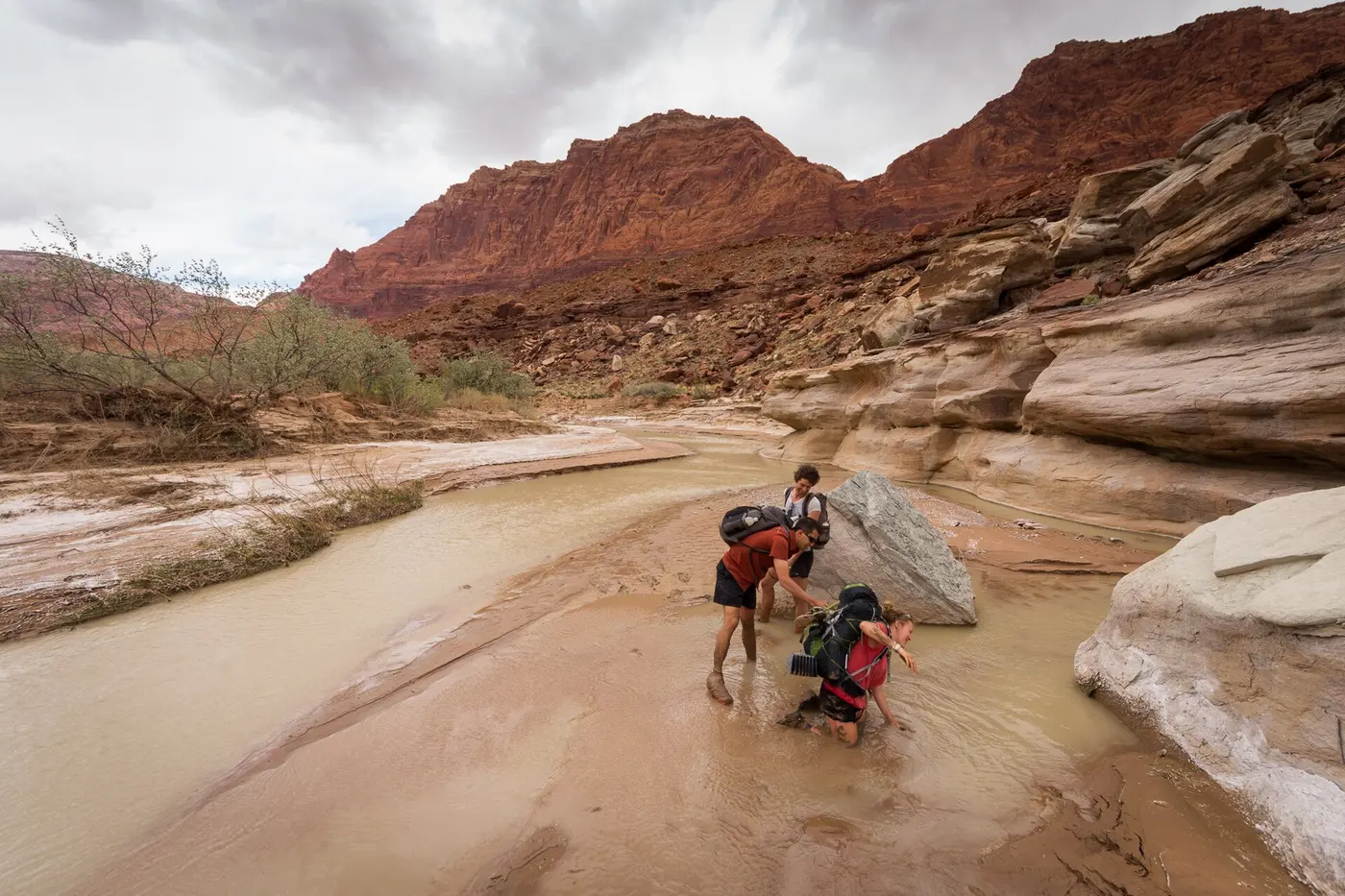

An experiment with sand from an Iranian salt lake
The team that recreated quicksand in the lab to see how far a person would sink was led by physicist Daniel Bonn of the University of Amsterdam in the Netherlands. The idea came from a trip to Iran. Near Namak Lake, a salt lake, Bonn saw signs warning visitors about quicksand, and local shepherds told him cautionary tales about it, including stories of camels being swallowed up.
Intrigued, Bonn brought a sample back to the Netherlands. Analysis showed it was made of fine sand, clay and salt water, so the team mixed up larger batches in the same proportions.
They then placed beads with a density of 1 gram per milliliter, the same as the human body, on top of their homemade quicksand and shook the container. The beads sank partway but never went more than halfway under. Publishing the results in Nature in September 2005, the team concluded that people and animals cannot be pulled all the way into quicksand and should sink only about halfway.
The reason is simple. As National Geographic reported at the time, quicksand has a density of about 2 grams per milliliter, roughly twice that of the human body. Because we are lighter than quicksand, buoyancy holds us up. Bonn said that a trapped person would sink only a little deeper than the waist: “I would say there would be some pressure on the chest, but not enough to cause serious trouble.”
As hard as lifting a car
So why is quicksand so dangerous? Left undisturbed, it is surprisingly firm. Even an aluminum ball, which at about 2.7 grams per milliliter is denser than quicksand itself, will rest on the surface. But when the researchers shook the container a bit harder, the ball sank to the bottom. In their measurements, increasing the stress on the quicksand by just 1 percent could make the sand flow a million times faster. When someone steps in or thrashes about, the sand suddenly behaves like a liquid, and the body sinks.
The trouble comes next. Once the sand collapses, the grains settle into a densely packed sediment that is extremely thick. The team estimated that pulling a foot out at 1 centimeter (0.4 inch) per second would take as much force as lifting a medium-size car. Bonn warned against having friends haul you out by force; they could pull you “into two pieces,” he said.
His advice is to move slowly. “The way to do it is to wriggle your legs around,” he explained. This opens a gap between your legs and the sand, letting water flow down and loosen it. Do it slowly and progressively, he said, and you can get out.
The real danger lies in quicksand by the sea. “The real danger of quicksand is that you can get stuck in it when the high tides come up,” Bonn told Nature in 2005.
When an earthquake turns the ground to quicksand
Something very similar can happen beneath an entire city during an earthquake. It is called liquefaction. The Japanese encyclopedia Nipponica describes it as water-saturated sandy ground behaving like a liquid when shaken, and notes that it is also called “quicksand phenomenon.” The shaking destroys the support between the grains, and the whole layer of ground turns into a dense liquid.
The textbook case is the Niigata earthquake in Japan on June 16, 1964. Ground liquefied along the Shinano River and on reclaimed land, and 310 of the 1,500 reinforced-concrete buildings in the city of Niigata were damaged. About two-thirds of those sank or tilted as a whole while staying largely intact. Some apartment blocks toppled over completely.
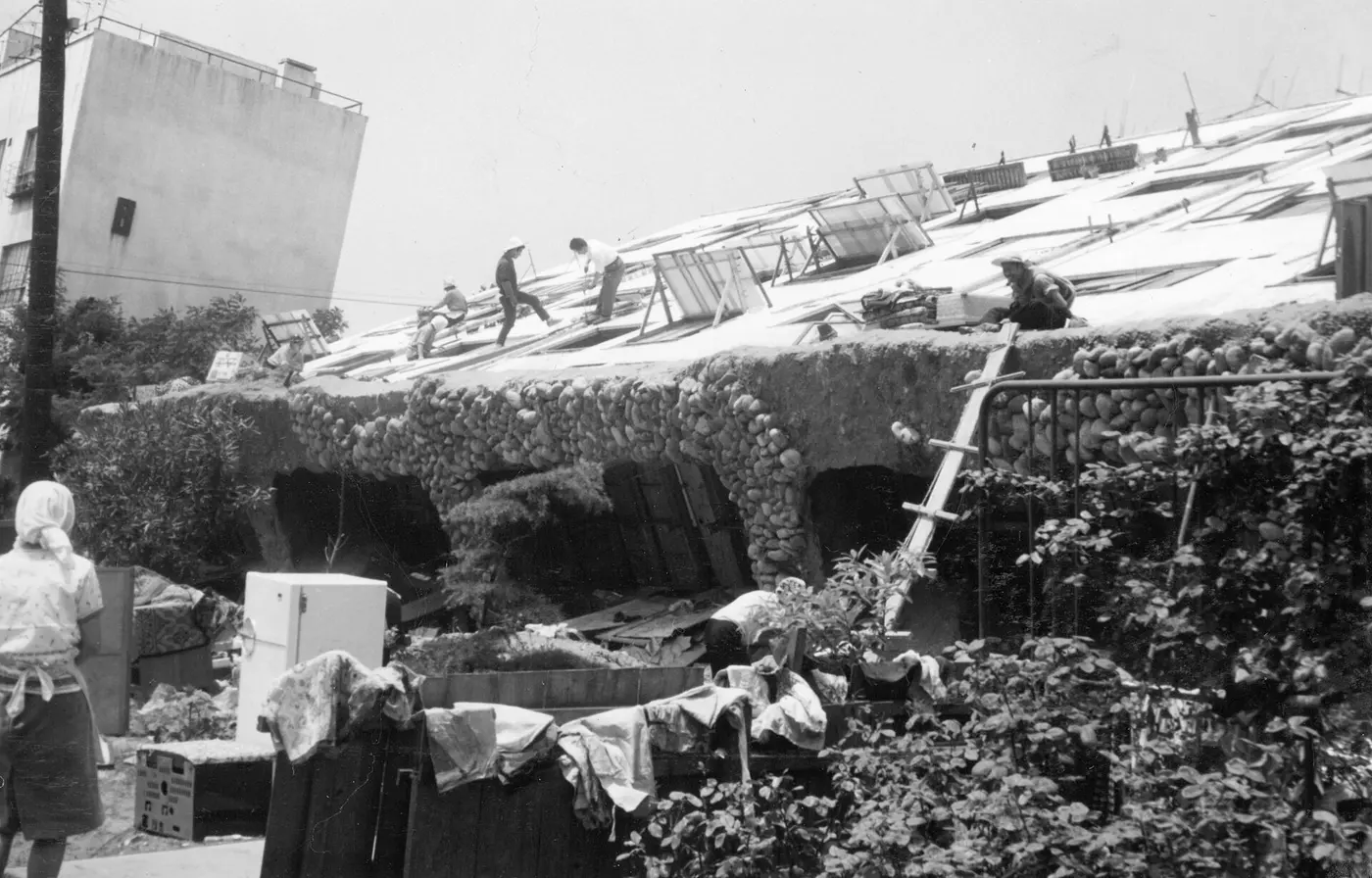

On liquefied ground, heavy buildings sink while light objects buried underground, such as manholes and pipes, float up to the surface. It is the same buoyancy that keeps a person in quicksand from sinking past the waist.