What share of the world’s earthquakes happen in Japan?
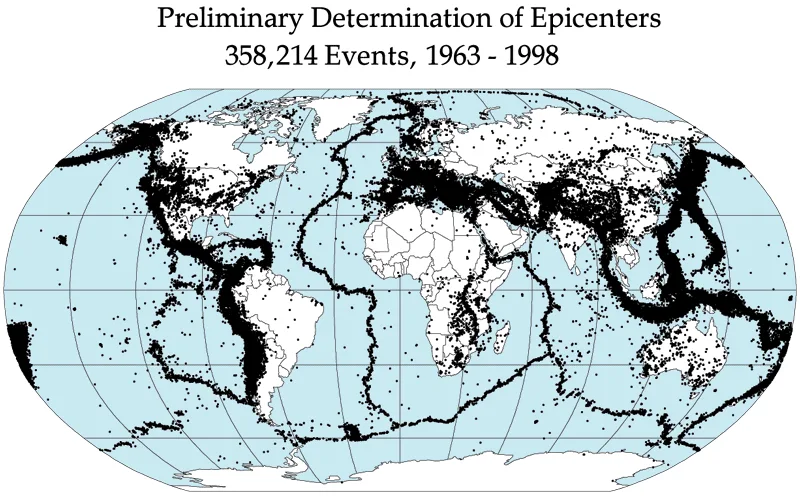
About 20 percent of magnitude 6 or larger earthquakes are said to strike in and around Japan, which covers only about 0.25 percent of the world’s area.
20%
According to the Japan Meteorological Agency (JMA), there were 4,456 earthquakes in 2025 that produced shaking of shindo 1 or higher on Japan’s 10-level seismic intensity scale. That works out to about 12 a day. The year before, 2024, there were 3,678.
For people in Japan, earthquakes are part of everyday life. But how big a share of the world’s earthquakes does Japan actually get?
0.25 percent of the land, 20 percent of big quakes
Japan’s 2013 white paper on disaster management, published by the Cabinet Office, states that about 20 percent of the world’s earthquakes of magnitude 6 or greater occur in and around Japan. A 2026 data book from Japan’s Ministry of Land, Infrastructure, Transport and Tourism (MLIT) makes the same point, adding that Japan covers only about 0.25 percent of the world’s area.
The ministry also gives recent figures. In the 15 years from 2011 to 2025, the world had 2,116 earthquakes of magnitude 6 or above. Of those, 350, or 16.5 percent, happened in and around Japan. Compared with its share of the world’s area, that is more than 60 times the concentration.
The exact share depends on which years you count. According to JMA, the median number of magnitude 6+ quakes in and around Japan over the past 107 years is 16 a year, but there were 30 in 2024 and 22 in 2025. “About 20 percent” is best taken as a rough guide.

More than ten felt quakes a day
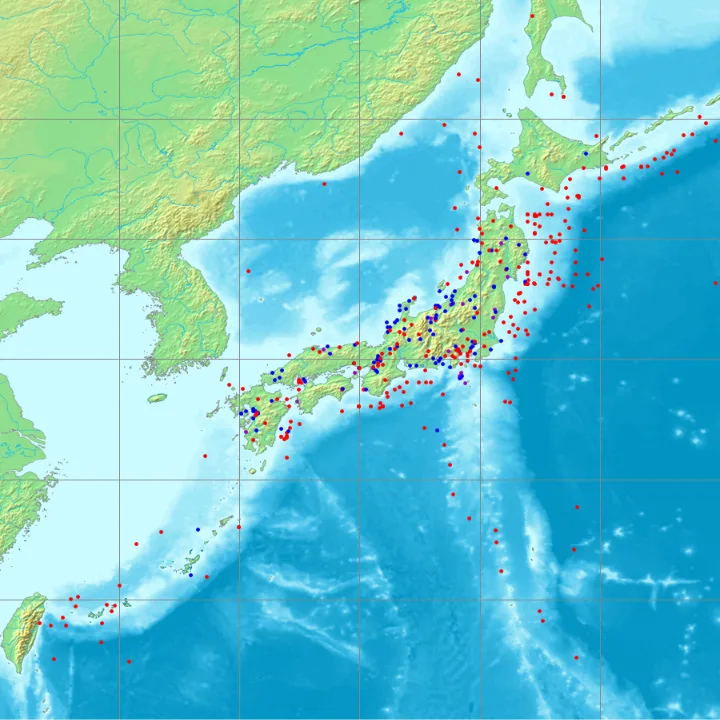
In and around Japan alone, magnitude 6+ earthquakes come along anywhere from a dozen or so to a few dozen times a year. Smaller quakes that people can feel are far more frequent.
Of the 4,456 earthquakes that reached shindo 1 or higher in 2025, 112 reached shindo 4 or higher and 15 reached 5-lower or higher. The strongest shaking of the year, 6-upper, came from a magnitude 7.5 earthquake off the east coast of Aomori Prefecture, at the northern tip of Japan’s main island, on December 8. On average, the ground is shaking somewhere in Japan almost every day.
Four plates and 2,000 faults
The reason lies deep underground. Japan sits where four tectonic plates meet: the North American, Eurasian, Pacific and Philippine Sea plates. Where an ocean plate dives beneath a continental one, strain builds up, and when it is released in a sudden slip, a large earthquake strikes.
The sources of quakes are not only under the sea. According to the 2013 white paper, about 2,000 active faults are known on land in Japan. The MLIT data book also notes that Japan has 111 active volcanoes, about 9 percent of the world’s total. Both the earthquakes and the volcanoes are closely tied to Japan’s position where plates collide.

Is Japan the most earthquake-prone country?
All this might suggest that Japan has more earthquakes than anywhere else. The US Geological Survey (USGS) says the question is not as simple as it seems and answers it four different ways.
The country where the most earthquakes are located is Japan. The whole country is in a very active seismic area, and it has the densest seismic network in the world, so it records a great many quakes.
But which country actually has the most earthquakes? According to the USGS, Indonesia. It is also in a very active zone, and because it is larger than Japan, it has more earthquakes in total. Per unit of area, the leaders are probably Tonga, Fiji or Indonesia, though sparse instruments there mean many small quakes go unrecorded. And for the most catastrophic earthquakes, the USGS points to China and Iran, with their long historical records, and also mentions Turkey.
Japan, in other words, is not only a country with a great many earthquakes. It is also the country that counts them most carefully.