Why are the numbers on a dartboard so jumbled?
So that a small miss costs a lot: the big numbers are placed right next to small ones.
198
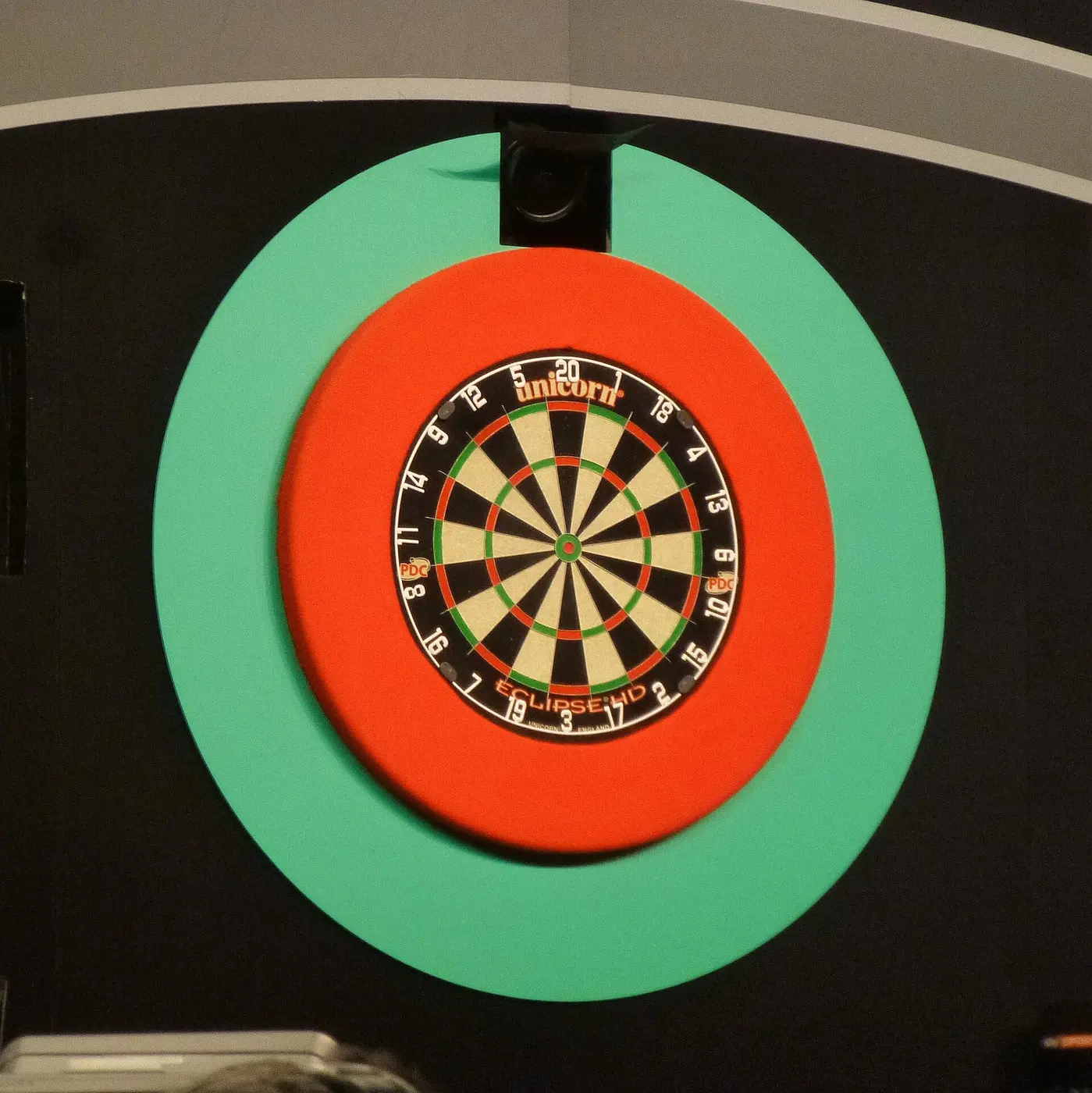
Look closely at the ring of numbers around a dartboard and something seems off. The 20 sits at the top, with a 1 to its right and a 5 to its left. Read clockwise, the sequence goes 20, 1, 18, 4, 13, 6, 10, 15, 2, 17, 3, 19, 7, 16, 8, 11, 14, 9, 12, 5.
Numbering the board 1 to 20 like a clock face would be far easier to read. So why the jumble?
Miss the 20 and you get a 1 or a 5
The answer becomes clear when you look at the most valuable spot on the board. Land a dart in the thin outer ring, the “double,” and you score twice the number; land it in the thin inner ring, the “treble,” and you score three times. The highest single score is the treble 20, worth 60 points.
But the 20 is flanked by the 1 and the 5. Stray a little, and the 60 you were aiming for turns into a 3 or a 15. The pattern repeats around the board: the 19 sits between the 3 and the 7, the 17 between the 2 and the 3. Big numbers are surrounded by small ones. Patrick Chaplin, a British historian of darts, explains that the numbers “are placed in such a way as to encourage accuracy.” Good throws are rewarded; sloppy ones are punished.
You can check this with simple arithmetic. Add up the differences between each pair of neighboring numbers, all the way around. If the numbers ran 1 to 20 in order, the total would be just 38. On the real board, it is 198. However you arrange the twenty numbers, that total can never exceed 200, so the standard board comes remarkably close to the theoretical maximum. What the “ideal dartboard” should look like has been a topic for mathematicians since at least the 1970s.

The inventor who may never have existed
So who devised the sequence? The usual answer is Brian Gamlin, a carpenter from Bury in Lancashire, in northwest England, who supposedly invented it in 1896 and died in 1903 without ever patenting it.
The trouble is that there is no solid evidence for any of this. According to Chaplin, the first time Gamlin’s name appears in a book is in a darts title published in 1979. Chaplin searched the records thoroughly and found no trace of a Gamlin dying in 1903. In his view, the man “never existed.”
Chaplin considers a different candidate more convincing: Thomas William Buckle, a craftsman from Dewsbury in Yorkshire, in northern England, who made dominoes among other things. Buckle is said to have converted a type of board known as a “fives” board into a 20-segment board in 1913. Why he chose this particular order is unknown. The earliest known appearance of the sequence in print is reported to date from 1916. Another theory holds that the arrangement began at fairground stalls, where it helped keep high scores rare.
The trebles came later
Buckle’s board became known as the “Yorkshire board.” Its numbers were in the same order as today’s, but it had no treble ring and no 25-point ring around the bull’s-eye. Someone added both between 1918 and 1924, and the resulting board was adopted by Britain’s National Darts Association when it was formed in 1925.
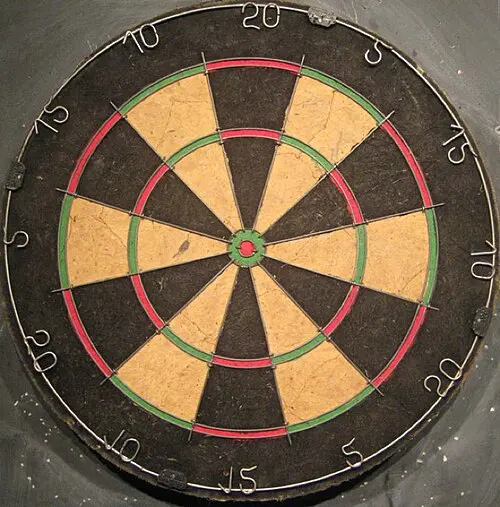

Today the World Darts Federation (WDF) sets out the details in its rules. Boards are made of compressed sisal fiber, with the 20 segment in the darker color at the top. The double and treble rings are just 8 millimeters wide, measured inside the wires. The center of the bull’s-eye must be 1.73 meters (5 feet 8 inches) above the floor, and the throwing line 2.37 meters (7 feet 9¼ inches) from the face of the board.
If you’re a beginner, don’t aim for the 20
The layout even changes where you should aim. American statistician Ryan Tibshirani and colleagues calculated where a player should aim to get the highest average score, depending on how widely their darts scatter around the target. A version of the work appeared in 2011 in Significance, a magazine of Britain’s Royal Statistical Society.
For an expert whose darts land within about 5 millimeters of the target, the treble 20 is indeed the best place to aim, for an average of about 43 points per dart. But for a player whose throws scatter by about 25 millimeters, aiming at the treble 19 gives an average of 15.8 points, beating the treble 20’s 14.9. For a beginner whose throws scatter by 60 millimeters, the best spot is a little below and to the left of the center, for an average of 12.4 points; aiming at the treble 20 drops that to 10.2. With the 1 and the 5 on either side of the 20, a miss there simply costs too much.