Is there really a “Blood Falls” in Antarctica?
Yes. Salty water rich in dissolved iron seeps from the end of Taylor Glacier in Antarctica and turns rust red as soon as it meets the air.
−17°C
In Antarctica’s McMurdo Dry Valleys, near the Ross Sea, Taylor Glacier flows into a valley with very little snow. At its end, a cliff of white ice is streaked red, as if blood had poured down it. The spot is known, fittingly, as Blood Falls.
It is not a waterfall in the usual sense. Reddish-brown water seeps out of the glacier from time to time, stains the ice, and runs into Lake Bonney below. More than a century after it was first seen, scientists are still studying its color.
1911: “a bright red alga”
The red stain was first seen by the geologist Griffith Taylor. According to Ohio State University, Taylor came across it in 1911 while exploring the valley that would one day bear his name. He was a member of the British Antarctic Expedition led by Captain Robert Falcon Scott, and he was working his way through the glacial valleys in February of that year.
In his 1916 book With Scott: The Silver Lining, Taylor described the scene beside the lake he named Lake Bonney: “just at the snout of the glacier a bright red alga lent an unusual touch of colour.” This is thought to be the red of Blood Falls. To Taylor, it looked like algae.
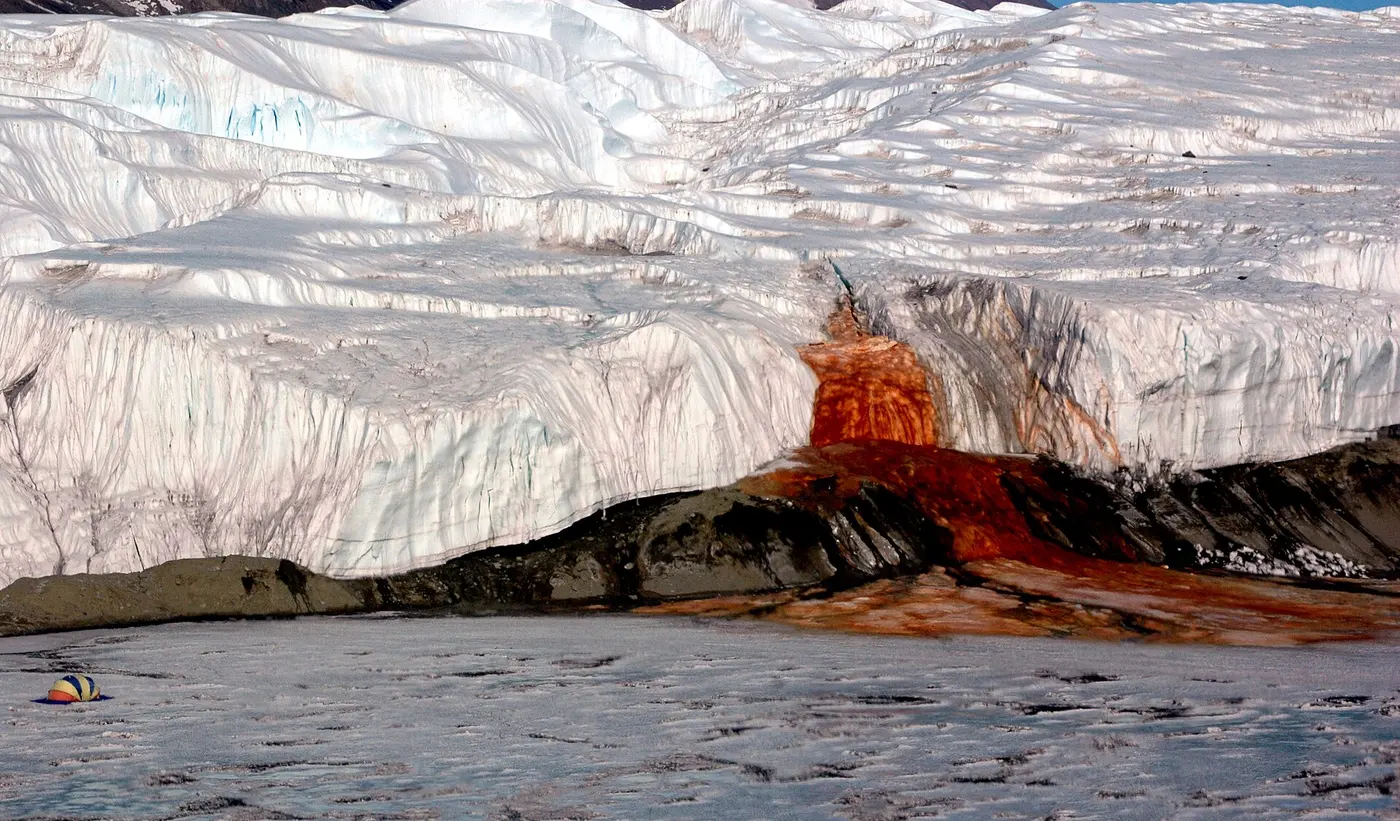

That idea changed about half a century later, in the mid-1960s. According to Ohio State University, Robert Black of the University of Wisconsin found that the red stain was actually iron salts, ferric hydroxide, being squeezed out of the ice.
Water that rusts in the open air
The water of Blood Falls carries a great deal of dissolved iron. While it is under the glacier, it has almost no contact with oxygen, so the iron stays dissolved. Once it emerges and meets the air, though, the iron combines with oxygen and turns red, much as an iron nail rusts.
The red material is not quite ordinary rust, however. In a 2022 study in a space science journal, American researchers analyzed the red deposits with a battery of techniques and found no clear sign of the crystalline iron oxide minerals of familiar rust. Instead they found tiny noncrystalline spheres, nanometers across, rich in iron and chlorine. The red color, they concluded, comes from dissolved iron turning into these nanospheres in the air.
The researchers note that identifying complicated materials like these takes several analytical methods used together, a lesson for exploring planets such as Mars.
A trapped sea beneath the ice
Where does the iron-rich water come from? In 2003, Berry Lyons and colleagues at Ohio State University proposed that it is a remnant of seawater from a time when the valley was more like a fjord open to the sea, possibly as much as 5 million years ago. The trapped seawater is thought to have been sealed in when the glacier advanced over it.
Surprisingly, there is life in this dark, cold brine. In a study published in 2007 by the microbiologist Jill Mikucki and a colleague, 74 percent of the bacteria found in water from Blood Falls had genes closely resembling those of marine bacteria. Then in 2009, Mikucki and her colleagues reported in the journal Science that microbes beneath the glacier, living in brine with no light and almost no oxygen, use iron and sulfur compounds to extract energy from organic matter. In the process, iron dissolves into the water, and it is this iron that turns red when it reaches the surface. The color of Blood Falls is, in part, the trace left by microbes living under the ice.
At the time, the iron at Blood Falls was usually explained by chemistry alone, with no life involved. “People said there wasn’t life,” Mikucki told The Dartmouth, the college’s student newspaper, in 2009. “The paradigm has shifted. People now see glaciers as ecosystems.”
Liquid at minus 17 degrees
How can water flow out of a glacier at all? The mean annual air temperature around Taylor Glacier is about −17°C (1°F).
In 2017, a team from Colorado College, the University of Alaska Fairbanks and other institutions used ice-penetrating radar to look inside the glacier and traced the brine’s path to Blood Falls. According to the team, two things keep the brine liquid. One is its high salt content: salty water freezes at a lower temperature than fresh water. The other is the heat released when water freezes. As part of the brine freezes, it gives off heat that keeps the water around it from freezing.
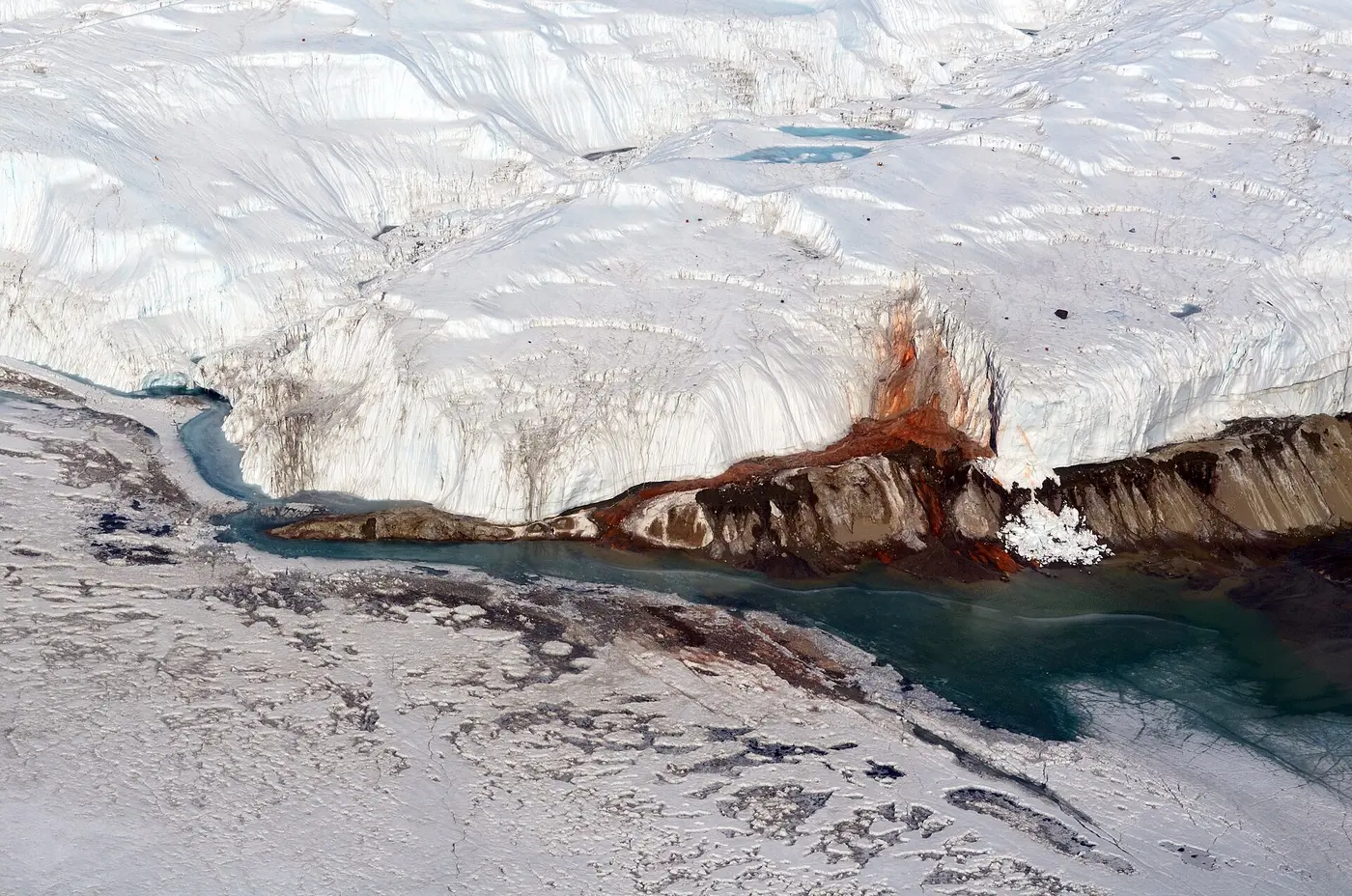

The glacier’s own weight seems to help push the brine out. According to a report published in January 2026, in September 2018 a GPS station on Taylor Glacier recorded the ice dropping by about 15 millimeters (0.6 inch), and at about the same time a camera trained on Blood Falls recorded an outflow of brine. The weight and movement of the glacier periodically squeeze the brine out from beneath the ice.